E.L. Taylor, K.C.: The Name on the Crescentwood Map
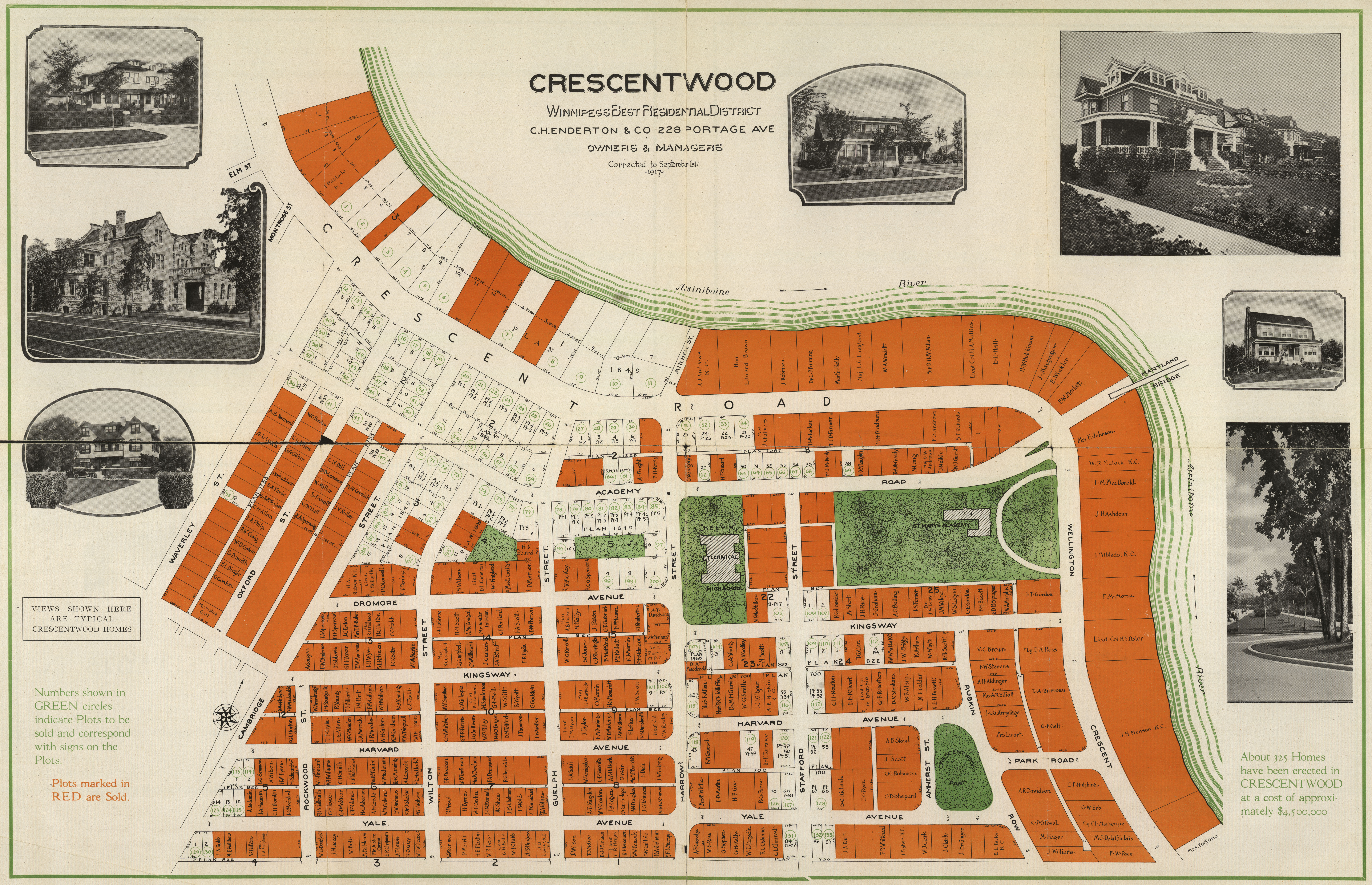
When I look out at my yard in Crescentwood, I think about what this land has seen. More than a century ago, a single name appeared on the title to this lot on a hand-drawn map of the neighbourhood: E L Taylor K C. That name, inked onto an early planning map near Ruskin Row and Yale Avenue, belongs to one of Winnipeg’s most fascinating characters of the early twentieth century, a teacher turned pioneer barrister, a businessman, a politician, and a pillar of the city’s booming Edwardian era. This is his story, and in a small way, the story of the ground beneath my feet.
From Ontario to the Prairies
Edmund Landor Taylor was born on December 14, 1860, in Leeds County, Ontario, the son of Mary Ann Redmond and Henry James Taylor, who would later serve as postmaster of Crystal City, Manitoba.[source] The family was part of the great wave of Ontario settlers who looked westward to the newly opened Canadian prairies in the years following Confederation.
In 1881, at just twenty years old, Edmund made the move to Manitoba, a territory that had only become a province a decade earlier.[source] It was a bold leap. Winnipeg was a raw, fast-growing city, barely more than a frontier town still finding its footing after the great land boom of the 1870s. But for ambitious young men from Ontario, it was brimming with opportunity.
His first role in the province was as Deputy Registrar of Rock Lake County, a position he held from 1881 to 1883.[source] He then furthered his education at the Winnipeg Collegiate Institute and the Manitoba Provincial Normal School, earning a First Class Teacher’s Certificate.[source] For three years, from 1883 to 1886, he shaped young minds as a schoolteacher, a grounding that would serve him well in the more combative arenas ahead.[source]
A Career in Law
Taylor set his sights on the law after teaching. The Manitoba Historical Society records that he was a law student (articling) with J. A. M. Aikins from 1888 to 1892[source], James Albert Manning Aikins, one of the most prominent legal figures in Manitoba’s history, who would later become Lieutenant Governor of the province.[source] It was an auspicious start. Taylor then continued his training with the prestigious firm of Tupper, Phippen & Tupper, and was finally called to the Manitoba Bar in 1895.[source]
He proved a formidable lawyer. In 1907, he was appointed King’s Counsel, the “K.C.” designation that would follow his name on that Crescentwood land map for the rest of his professional life.[source] The distinction was a mark of exceptional legal ability and standing, awarded only to the most distinguished barristers of the era.
Taylor was no quiet solicitor working behind closed doors. His practice placed him at the intersection of law and commerce, and he became deeply embedded in the financial life of Winnipeg during its most explosive period of growth.
Businessman and Civic Figure
The early 1900s were a golden age for Winnipeg. The city’s population exploded, grain fortunes were being made, and ambitious men were building institutions to match the city’s ambitions. Taylor was squarely in the middle of it. He served as a Director of the Great West Permanent Loan Company, the Canada National Fire Insurance Company, the Imperial Canadian Trust Company, the Monarch Life Assurance Company, and the Royal Canadian Securities Company.[source]
He was also President of the Similkameen Fruit Land Company, President of the Northern Investment Company, and President of the Victoria Public Hospital.[source] His portfolio reads like a who’s-who of early western Canadian enterprise. This was not a man content to practice law from a single office; he was helping build the economic architecture of a young city and province.
His civic and academic involvement was equally broad. He served as a Member of the Council for the University of Manitoba and as a Member of the Board of Trustees for Wesley College.[source] He was a committed member of the Manitoba Club and the Adanac Club, a Fellow of the Ancient Free and Accepted Masons and the Independent Order of Odd Fellows, a Conservative, and a Methodist.[source]
In the Headlines: Finance, Politics, and the Press
Taylor’s business ties occasionally thrust him into public controversy. In the late 1920s, newspapers across Canada carried stories about shareholder battles and regulatory scrutiny involving companies with which he was associated, drama that played out in boardrooms and in the columns of the financial press.
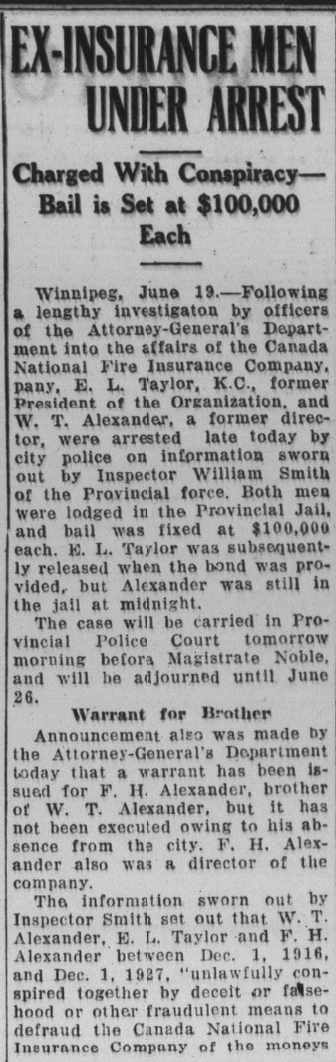
The Oshawa Daily Times reported in June 1929 that, following an investigation into the affairs of the Canada National Fire Insurance Company, Taylor and another former official were arrested on information sworn by provincial authorities; the piece noted high bail and upcoming court dates. Contemporary accounts are a reminder that the same institutions that built the West also faced intense public and legal scrutiny when fortunes turned.
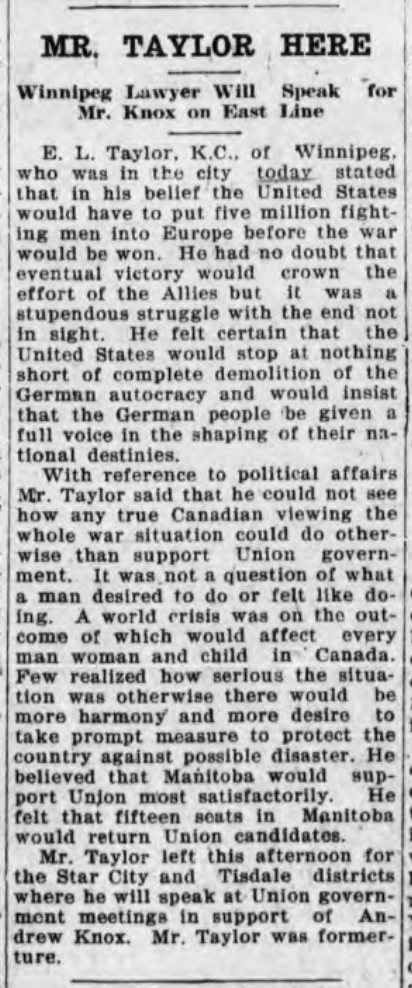
Earlier, during the First World War, Taylor was quoted in the Prince Albert Daily Herald while travelling as a Winnipeg lawyer, speaking on the war effort and Union government, another glimpse of a public man moving between law, politics, and the speaking circuit.
And when factions vied for control of the Great West Permanent Loan Company, Victoria’s Daily Times described meetings where Taylor and other officials were expected to answer challenges from rival shareholders, evidence of how closely Winnipeg’s financial elite were watched from coast to coast.
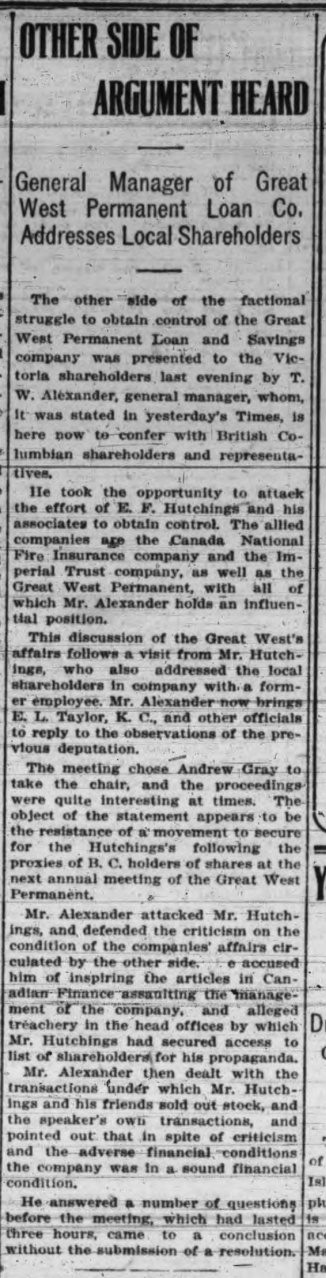
Reading old news: Clippings reflect what was reported at the time, not a final verdict on any matter. They help illustrate how visible Taylor was in business and public life, and how fiercely the newspapers of the day covered prairie finance.
A Politician’s Perseverance
Taylor’s political ambitions were real, but they were not easily satisfied. He first sought federal office as the Conservative candidate in a Winnipeg by-election called after Hugh John Macdonald’s previous election was declared void.[source] The Manitoba Historical Society describes this contest as an 1896 federal by-election[source]; parliamentary records and Wikipedia place the same race on 27 April 1894.[source] Sources disagree on the year; we give 1894 here because it matches the parliamentary record, but readers should be aware of the discrepancy. He lost to Liberal Richard Willis Jameson by over a thousand votes.[source]
He tried again provincially in 1910, running in the Mountain constituency, and was defeated by the Liberal candidate James Baird by 282 votes.[source] Politics, it seemed, was not prepared to reward him easily. But Taylor was not a man who gave up.
His persistence paid off in 1913. On May 12 of that year, he won a provincial by-election in the riding of Gimli, defeating the Liberal candidate A. Eggerston by 842 votes.[source] He took his seat in the Legislative Assembly as a backbench supporter of Premier Rodmond Roblin’s Conservative government.[source] The following year, he held his seat in the 1914 general election, winning the constituency of St. George by defeating Liberal Skuli Sigfusson by 101 votes.[source]
His time in the legislature was brief, the Roblin government was consumed by scandal in 1915 and the Conservatives were swept from power[source], but Taylor had achieved what he set out to do: serve his province as an elected representative.
Life in Crescentwood
By the time Taylor’s name appeared on that land map near Ruskin Row, Crescentwood was the address of choice for Winnipeg’s professional class. The neighbourhood had been developed from 1904 onwards by real estate agent C.H. Enderton, who laid out Yale, Harvard, Kingsway, and Dromore Avenues and attracted the city’s wealthiest residents during the boom years leading up to the 1913 recession. For more on the area, see our history of Crescentwood and the original residents of Ruskin Row.
Taylor’s primary Crescentwood address was 611 Wellington Crescent, a magnificent 2½-storey brick and Tyndall stone home measuring 58 by 60 feet, designed by the celebrated local architect John Nelson Semmens.[source] Construction began in mid-1911 and was completed in early 1912, built by the construction firm of Davidson Brothers at a cost of around $30,000, an enormous sum for the era.[source] The Winnipeg Tribune called it a “$30,000 residence for Wellington Crescent” upon its announcement in May 1911.[source]
On March 5, 1902, Taylor had married Una Caroline Preston (1878–1966), daughter of A.F. Preston of Bethany, Ontario.[source] The couple had two children: a daughter, Caroline, and a son, Gordon Edmund Taylor, born in 1904.[source] It was this family that filled those fine rooms on Wellington Crescent during Winnipeg’s most optimistic years.
As for the land near Ruskin Row that he held (the very ground this post is written about) it was almost certainly an investment lot, held as part of his broader involvement in the property and investment markets of the era. Men of his standing routinely acquired Crescentwood lots during the boom years as the neighbourhood took shape around them.
The Map: His Name, and the Lots Today
The planning map preserved with this article is a beautifully detailed original of the Crescentwood subdivision. You can pick out Crescentwood Park on Amherst Street, the curving line of Ruskin Row, and the handwritten names of early lot owners. Beside “J. Erzinger” and “J. Clark”, you will find it, clear as day: E L Taylor K C, written across a single parcel.
Then and now: On the historic plan, Taylor’s holding appears as one lot. Today the street grid has been subdivided further, smaller lots and newer addresses sit where that one block was drawn. The ink name is a snapshot of the boom-era plan; the modern cadastre tells the story of how the neighbourhood was carved up in the decades since. Holding the map next to a current aerial view is the quickest way to see both layers at once: his name on paper, and today’s lots underneath our Crescentwood home.
A Pioneer Barrister’s Final Years
Taylor lived through Winnipeg’s boom and its long, difficult aftermath, the 1913 recession, the First World War, the turbulent 1920s. The city that had seemed boundlessly expansive when he had built his Wellington Crescent home contracted, changed, and matured around him.
Edmund Landor Taylor died in Winnipeg on September 9, 1934, at the age of 73.[source] The Winnipeg Free Press marked his passing with the headline: “E.L. Taylor, pioneer barrister, is dead.”[source] He was buried at St. James Cemetery.[source] His wife Una lived on until 1966, outliving him by more than three decades.[source]
The Wellington Crescent house he had built with such pride had a poignant postscript. When the adjacent Shriners’ Hospital for Crippled Children was constructed next door at 633 Wellington Crescent, the Taylor home was converted into a nurses’ residence.[source] It stood until October 2022, when it was demolished along with the hospital.[source] After more than a century, that chapter of the Crescentwood streetscape is gone.
The Name on the Map
There is something quietly extraordinary about finding a name on a century-old land map and being able to trace it back to a full, vivid life. E.L. Taylor K.C. was not a household name even in his own day; he was one of dozens of capable, driven men who helped build the institutions, streets, and neighbourhoods of early Winnipeg. But he was real, he was here, and for a time, the ground beneath my home was his.
Beside “J. Erzinger” and “J. Clark”, you’ll find it: E L Taylor K C. Holding a lot. Planning, perhaps, to build. Or simply investing in a neighbourhood that he, like so many of his generation, believed was destined for greatness. A hundred-odd years later, someone else lives here. But the land remembers.
Sources
- Manitoba Historical Society
- Wikipedia (biographical and Crescentwood context)
- Historic Sites of Manitoba
- Crescentwood, Winnipeg (Wikipedia)
- Winnipeg Free Press, 10 September 1934
- Contemporary newspapers as cited above (Oshawa Daily Times, Prince Albert Daily Herald, Victoria Daily Times)