The History of Crescentwood: Winnipeg's Most Prestigious Neighborhood
Staying at our Airbnb on Ruskin Row puts you inside one of Winnipeg's most historically significant neighborhoods. Crescentwood, the district where our home is located, has a rich and fascinating history that dates back to the early 20th century, when it was developed as an exclusive residential area for Winnipeg's wealthiest citizens.
The Origins of Crescentwood
Crescentwood's story begins with the original land parcels, which were long, narrow lots running from the Red River southwest to Cambridge Street. The largest of these, Parish Lot No. 43 St. Boniface, changed hands many times until 1889, when it was purchased by John Henry Munson, who built a substantial home on the Assiniboine River.
When the C. H. Enderton Company purchased a large parcel of the land for subdivision and development, a representative approached Munson and asked if the new district could be named after his home, Crescentwood. Munson agreed, and thus one of Winnipeg's most distinguished neighborhoods was christened.
C. H. Enderton: The Visionary Developer
Charles H. Enderton, born in Lafayette, Indiana in 1864, came to Winnipeg in 1890 after working as a lawyer in St. Paul, Minnesota. He made a tremendous success of his career in real estate, becoming one of the city's most prominent citizens through his many memberships and board positions.
Enderton's development of Crescentwood began in earnest around 1902, when he laid out streets such as Yale, Harvard, Kingsway, and Dromore Avenues. He also acquired properties to create Oxford Street and the east side of Waverley Street up to Wellington Crescent. This strategic planning attracted many of Winnipeg's wealthiest residents between 1904 and 1913, leading to the construction of grand homes that defined the neighborhood's character.
Interesting Fact: When C. H. Enderton died in 1920, he left an estate of $1,200,000, the largest estate probated in Manitoba since the death of Donald A. Smith, Lord Strathcona, in 1914. After remembering some charities in Winnipeg, such as the Children's Hospital, he left the residue of his estate to his alma mater, DePauw University.
Wellington Crescent: From Indigenous Trail to Grand Boulevard
Wellington Crescent, one of Crescentwood's most prestigious streets, was once a trail used by Indigenous peoples, following the curves of the Assiniboine River. In 1893, it was named Wellington Street after lawyer Arthur Wellington Ross, who came from Cornwall, Ontario and purchased land in Fort Rouge. The street would become home to some of Winnipeg's most magnificent residences.
Notable Homes and Residents
Crescentwood became home to many of Winnipeg's most prominent citizens. Along Wellington Crescent, grand houses were built for:
- James Ashdown (529 Wellington Crescent) - A tinsmith who came to Winnipeg in 1868, went into the hardware retail and wholesale business, and served as mayor of Winnipeg in 1907-8. Ashdown was one of the most important businessmen in Western Canada.
- James T. Gordon (514 Wellington Crescent) - Of the meatpacking firm Gordon, Ironside and Fares
- Victor Sifton (514 Wellington Crescent) - Publisher of the Winnipeg Free Press and related chain of western newspapers
- Mark Fortune (393 Wellington Crescent) - A real estate dealer who tragically lost his life on the Titanic along with his son, while his wife and three daughters were rescued
- Elisha F. Hutchings (424 Wellington Crescent) - Founder of The Great West Saddlery Company, who came to Manitoba in 1876 and became very successful in manufacturing and wholesale
The "Monster Mansion" at 10 Ruskin Row
Perhaps the most legendary home in Crescentwood's history was the mansion at 10 Ruskin Row, often referred to as the "Monster Mansion." This extraordinary residence was built in 1912-1913 for Alexander Rae Davidson, a prominent banker who owned several banks in Minnesota and the Dakotas.
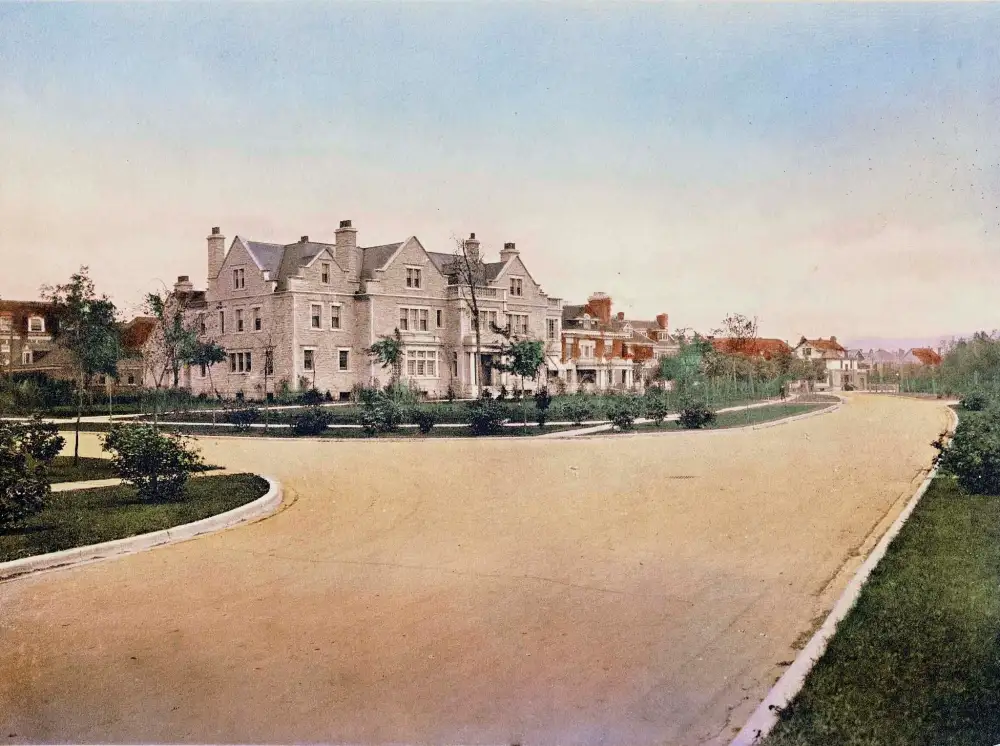
Designed by Minneapolis architect William Channing Whitney, the mansion was styled like an English manor house, constructed of Indiana stone with Vermont limestone trim. It was the most ambitious of the homes built prior to World War I, featuring:
- 37 rooms of extraordinary opulence
- A ballroom measuring 60' x 25' in the basement
- Nine fireplaces throughout the home
- An elevator for easy access between floors
- A garage with a turntable for automobiles, a remarkable feature for the era
The construction cost was approximately $150,000, a staggering sum for that era, equivalent to millions in today's dollars. The home was so impressive that Russell, Lang & Co. included it in a book of Winnipeg postcards soon after it was built, cementing its status as one of the city's architectural marvels.
Tragically, despite its grandeur and historical significance, the mansion was demolished in 1963. The Art Gallery of Winnipeg even conducted a tour of the Davidson home before its demolition, recognizing its importance. The land was subsequently divided into three lots, and a smaller, modern home with the same address was built in 1974 by architect Peter Wreglesworth.
Today, when you walk along Ruskin Row, you can still sense the grandeur that once defined this street. Our Airbnb is just a few doors down from where this magnificent mansion once stood, allowing you to experience the same prestigious location that attracted Winnipeg's elite over a century ago.
Learn More: For a comprehensive walking tour of Crescentwood's historic homes and landmarks, visit the Manitoba Historical Society's Crescentwood walking tour. You can also read more about the Monster Mansion in this article from the Winnipeg Free Press.
Other Notable Ruskin Row Homes
Ruskin Row itself has a rich architectural history. Other notable homes on the street include:
- 6 Ruskin Row - Built in 1910 by Chester D. Stovel, a pioneer engraver, printer and lithographer, after a design by Victor Horwood. The house features 20 rooms with 2,500 square feet of space on the main floor for entertaining, Circassian Walnut panelling in the dining room, and original Scottish-made stained glass windows.
- 12 Ruskin Row - Built in 1910-11 by lawyer A. C. Ewart, later occupied by Ethelbert W. Kneeland, president of his own grain company and manager of the British Elevator Company. The Italianate style home features a shallow pitched roof, symmetrical composition, and wrought iron trim.
- 2 Ruskin Row - An early occupant was Frank Druxerman, who managed the Savoy Hotel. During the 1940s, Winnipeg sororities bought this house to use for meetings.
Crescentwood Today
Today, Crescentwood remains one of Winnipeg's most desirable neighborhoods, blending its historical charm with modern amenities. The community's commitment to preserving its architectural heritage is evident in the well-maintained homes and the ongoing efforts to designate Crescentwood as a heritage conservation district.
A stay with us is a comfortable, well-designed mid-century modern home and a piece of Winnipeg's history at the same time. The tree-lined streets, the grand homes that still stand, and the stories embedded in every corner of this neighborhood make Crescentwood a truly special place to visit.
Take a walk along Wellington Crescent, explore Ruskin Row, or visit nearby Munson Park (the site of the original farmhouse on what used to be Munson's farm). You'll be following in the footsteps of Winnipeg's early 20th-century elite, experiencing the same prestigious neighborhood that has captivated residents and visitors for over a century.