Warming Huts 2027 at The Forks: Winnipeg Art on Ice
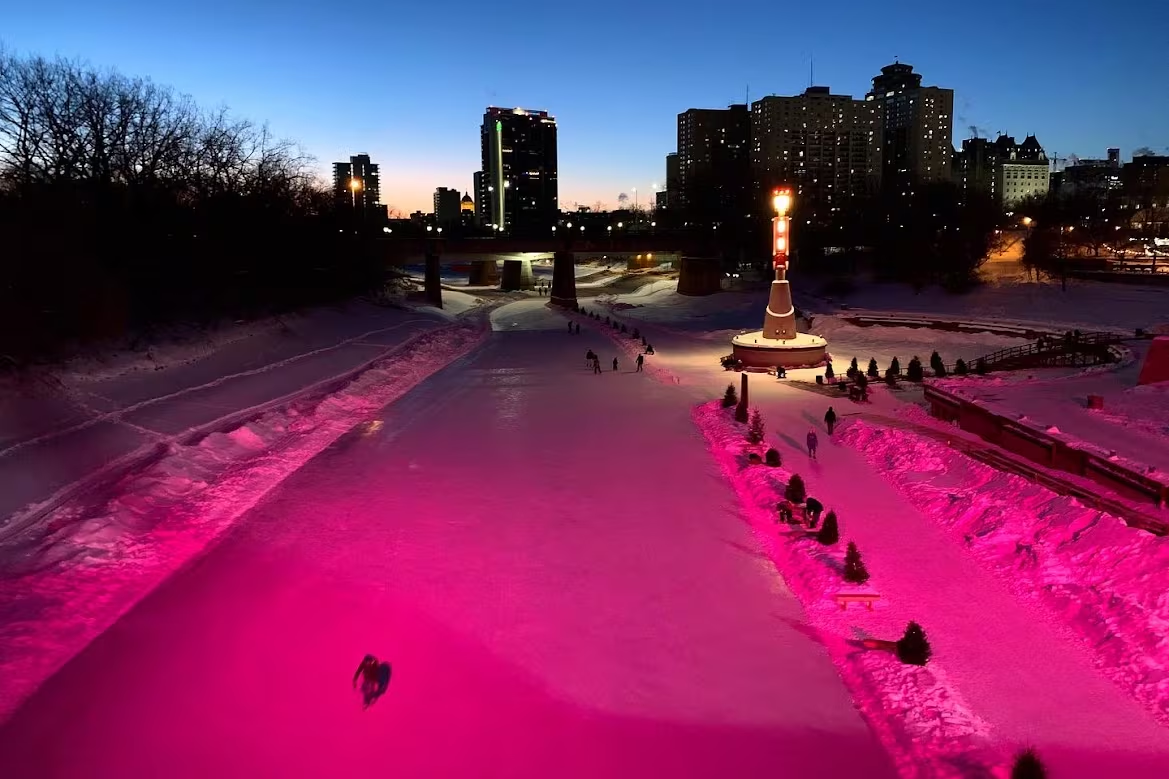
Winnipeg's Warming Huts go up on the frozen rivers in late January and stay out through February. The competition behind them, Warming Huts: An Art + Architecture Competition on Ice, has run since 2009, and the finished structures are installed along the Nestaweya River Trail presented by The Winnipeg Foundation, on the ice at The Forks where the Red meets the Assiniboine. Build week has lately landed in the third week of January, which is a guess the organisers revise every year according to how thick the ice is. Winners for 2027 are announced in December.
What follows is the trail walked from its western end, which is the end nearest the Crescentwood blocks, rather than from the car park at The Forks where nearly everyone starts.
Upstream end: the Hugo Docks to the Donald Street Bridge
The Assiniboine leg begins at the Hugo Docks, where Hugo Street runs out at the river in the residential streets north of Corydon Avenue. In a good year the full trail measures about six kilometres from here to Churchill Drive on the Red, with The Forks sitting near the middle of it, so this first stretch into the city centre is roughly three kilometres and forty minutes at a walking pace. On skates it is half that. Which access points are cut and staircased varies: The Forks opens sections as the ice allows and closes them again for cracks or for grooming machines that cannot reach a stretch, so the Hugo end is not guaranteed in any given week.
It is a quiet walk, and that is the argument for doing it this way around. The Assiniboine here runs between high banks lined with the back gardens of Wellington Crescent, and sound drops away almost completely once you are down on the ice. You pass under the Maryland and Osborne Street bridges, then the Donald Street Bridge, each one arriving as a cold shadow and a change in the wind. Huts are thin on the ground this far out. The ones you do meet are usually the returning structures from earlier years, moved out from the confluence to spread the trail's attractions along its length.
The confluence, where the new huts stand
The density changes as the river opens out at The Forks. This is where the new season's huts are grouped, within a few hundred metres of each other and of the ramps up to the Market, and where the ones that need an audience are put. The 2026 edition drew more than two hundred submissions and seven designs were chosen from them: Moon Rabbit by Yu Liu of Shanghai, Wildlife Scramble by Charles Sharpless and Jessica Colangelo of Fayetteville with Adrian Gonzalez and Ashley Colangelo of Gainesville, and Dram by Noel Picaper of Paris with Joffrey About of Brussels. Franziska Agrawal of Munich came as the invited artist and built Continuum, a thirty-metre passageway of compacted snow arches set on the ice at the junction of the two rivers. Grade seven students at Bison Run School won the school category with Warm Up With a Great Book, and the University of Manitoba's Faculty of Architecture added a structure of stairs and bridges named for the architect John Hejduk.
None of those are promised for 2027. The point of listing them is that the lineup is not a set of identical plywood shelters: in a given winter you will find something you walk through, something you climb, something that makes noise, and at least one piece that offers no shelter at all and is simply an object standing on a river. The competition has been collecting these since 2009, supported from the start by Sputnik Architecture, and it has pulled in work from Frank Gehry and from Anish Kapoor, whose Stackhouse was cut from ice taken out of the Red itself with the Norway-based sculptor Luca Roncoroni. Three teams win each year. Each project runs on a creation and construction budget of $16,500, of which up to $3,500 is the designers' fee, which tells you something about why the results tend to be ingenious rather than lavish.
Skates are rented at the counter in The Forks Market Atrium, 1 Forks Market Road, beside the changing area, at $8 for adults and $4 for children and seniors. The two maintained on-land rinks, the CN Stage Rink and the Canopy Rink, sit above the river bank and stay open when the ice below does not, which is the fallback on a day the trail is closed. If you want a guide rather than a map, The Forks has run Warming Hut Tours on selected Saturdays once the huts are up; in 2026 those began on January 24.
Downstream to Churchill Drive, and what the walk costs you
From the confluence the Red leg runs south under the Norwood Bridge toward the trailhead at Churchill Drive, with a further access point at the Queen Elizabeth Bridge. This is the exposed half. The Red is wider than the Assiniboine and the banks are lower, so the wind has a clear run at you for a kilometre at a time, and a windchill that was tolerable on the Assiniboine will send you back after fifteen minutes here. Go south only if the day is still.
Light is the other constraint, and it is the reason to walk the trail in this direction rather than the reverse. The sun sets in Winnipeg at about 5:16 p.m. on January 30 and has reached only about 5:40 p.m. by the middle of February, so an afternoon that begins at the Hugo Docks arrives at the confluence with the huts lit and the trail lamps on, which is when the structures are at their best. Start at The Forks instead and you finish in the dark on the quietest and least lit part of the river. The 38 Salter runs into The Forks seven days a week, and there are stops on Main and on Broadway by Union Station if you want to ride back rather than retrace three kilometres; the 2026 fare is $3.45 in cash or $3.10 on peggo e-cash, and drivers carry no change.
Dress for standing still. Most of the time on this walk is spent stopped, looking into a hut or waiting for someone else's photograph, and that is a different thermal problem from walking. Boots with a real sole beat skates for anyone who wants to get inside the structures, since several of the huts sit up on the bank or on snow rather than on cleared ice.
Where to stay for the Warming Huts
Our three-bedroom home is in Crescentwood, a few blocks south of Corydon Avenue, and the Hugo Docks trailhead is about a ten-minute walk north from the door. That is the practical reason to put the huts on a list of things to do from here: on a cold week you can test the trail, turn back after ten minutes if the wind is wrong, and try again the next afternoon without having driven anywhere. The Forks end is roughly ten minutes away by car, or twenty-five by bus on the D19 Corydon and a connection downtown.
Late January and February are the weeks when the huts and the Festival du Voyageur overlap, with the on-land winter park at The Forks open across both. They are the busiest winter dates we take. Our Airbnb listing shows which of them are open. If you want the trail itself rather than the huts, our guide to the Nestaweya River Trail covers how it is built and maintained.
Before you go: The huts' installation date, the trail's length and which access points are open change every winter and sometimes week to week. Check theforks.com for trail status before you set out, and winnipegtransit.com for the current fare.